

Bonded Leather vs. Genuine Leather: The Label Deception You Need to Know About
Youre looking at a jacket. The tag says leather. The price feels reasonable. It looks great in the store. Two years later its peeling off your body in strips. Heres everything you need to know about bonded leather vs genuine leather — and how to make sure it never happens to you again.
The leather industry has a labelling problem. Not because the rules dont exist, but because the rules are easy to exploit — and many brands are happy to exploit them. The word leather appears on products that contain as little as 10% actual animal hide. The rest is glue, plastic, and ground-up leather dust. It looks like leather on the shelf. It doesnt behave like leather anywhere else.
This blog is about exactly that gap — between what the label says and what youre actually buying. Well explain what bonded leather really is, why it always fails, what genuine leather actually means on a tag (its not what most people assume), and how to spot the difference before you spend your money on something that wont last the year.
First: The Leather Quality Ladder Nobody Talks About
Most people assume leather is a single material. It isnt. Its a broad category that covers everything from world-class full-grain hides to compressed leather dust held together with polyurethane. There are four distinct grades, and they are not remotely equal — but all four can legally appear under the word leather on a product label.
The reason this matters is that the label genuine leather — which sounds like it means real, authentic leather — actually refers specifically to the third tier: the lowest grade of actual single-piece hide. Anything below that, including bonded leather, is technically not genuine leather at all — yet the word leather still appears on the label because the product contains some leather content, however minimal.
When a product says genuine leather it doesnt mean high quality. It means it passed the minimum bar for the word leather to appear legally. A label that just says leather with no further detail is almost always hiding something. Ask what grade. If the brand cant or wont tell you, thats your answer.
What Bonded Leather Actually Is
What is bonded leather, exactly? Also sold under names like reconstituted leather, blended leather, leather blend, or simply leather — bonded leather is a manufactured composite material. Here is exactly what goes into it and how its made, because once you understand the construction, the inevitable peeling makes complete sense.
The process starts with the scraps and shavings left over from genuine leather production — the off-cuts, the trimmings, the unusable remnants. These are collected, mechanically shredded into fine fibres (typically less than 2mm), and ground into a pulp. That pulp — which contains real leather fibres but in a completely disintegrated form, with no continuous fibre structure remaining — is then mixed with a liquid polyurethane or latex binder.
This mixture is spread onto a fabric or paper backing sheet, pressed flat, and dried. The resulting sheet is then embossed with a stamped grain pattern to make it look like real leather grain, dyed to the desired colour, and coated with a polyurethane surface finish to give it a realistic sheen. The final product contains roughly 10–20% actual leather content by weight. The rest is plastic and adhesive.
Left: Bonded leather — four separate layers held together with adhesive. The failure zone between the PU binder and fabric backing is where peeling always begins. Right: Full-grain leather — a single, continuous piece of animal hide with no layers, no glue, and an intact collagen fibre network.
Why Bonded Leather Always Peels — Its Not a Defect, Its Physics
When people complain that their bonded leather jacket or sofa is peeling, brands often imply its a care issue — that they didnt condition it properly, or got it wet, or stored it badly. This is not true. Bonded leather peels because of how it is made, not how it is used. No amount of conditioning, careful storage, or gentle handling prevents it. The failure is built into the material at a structural level.
Heres why. Real leather is a single continuous piece of hide — the collagen fibres run throughout it as one interconnected network. When it flexes, stretches, or compresses, those fibres move together as a unified structure. There are no layers to separate, no adhesive bonds to fail.
Bonded leather, by contrast, is made of completely separate layers held together by adhesive. Every time the material flexes — every time you sit down, stand up, bend your arm, or simply wear the jacket through a day of normal movement — the layers experience slightly different stresses and strains. The PU surface layer, the leather-dust-and-binder layer, and the fabric backing all have different elasticity and thermal expansion rates. Over time, these repeated micro-stresses weaken the adhesive bonds between layers.
Heat accelerates this. Humidity accelerates this. UV light accelerates this. Most bonded leather products begin showing surface cracking within two to three years of regular use. By year five, significant delamination — where the surface layer lifts, curls, and peels away in flakes — is essentially universal. And once it begins, it cannot be stopped or repaired. The failure is terminal.
A bonded leather jacket at $150 that lasts 2 years costs you $75 per year of use. A full-grain leather jacket at $189 that lasts 25 years with basic care costs you $7.56 per year. The cheap option is almost always the more expensive one over time — it just doesnt feel that way at the point of purchase.
Side by Side: Bonded Leather vs Genuine Leather
| Factor | Bonded Leather | Full-Grain Leather |
|---|---|---|
| What it actually is | 10–20% leather dust + 80–90% polyurethane binder on fabric | 100% solid animal hide, continuous fibre structure |
| How its made | Shredded scraps ground, mixed with PU, pressed and embossed | Full hide tanned and finished, grain intact |
| Typical lifespan | 2–3 years before peeling; often less with heavy use | 20–30+ years with basic conditioning |
| Does it peel? | Yes — always. It is a structural inevitability, not a defect | No — real leather does not peel or delaminate |
| Can it be repaired? | No — once peeling begins, damage is permanent and progressive | Yes — scratches, scuffs, and dryness are all repairable |
| Develops patina? | No — surface is sealed plastic that wears away, not ages | Yes — deepens, richens, and improves with every year |
| Breathability | None — PU surface is airtight | Natural breathability through intact grain pores |
| Smell | Chemical or plastic odour, especially when new | Rich, natural, earthy leather scent |
| Surface feel | Plasticky, slightly stiff, uniform | Soft, supple, natural variation in texture |
| Label language | Leather, bonded leather, blended leather, reconstituted leather | Full-grain leather, top-grain leather, or clearly specified hide type |
| Price signal | Suspiciously affordable for leather | Higher upfront — justified by decades of use |
How to Spot Bonded Leather Before You Buy
The good news is that once you know what to look for, bonded leather is not that hard to identify. Here are the most reliable signals:
1. Read the label carefully — all of it
Look for the words bonded, blended, reconstituted, or composite anywhere near the word leather. If the label just says leather with no grade specified, ask. If the brand cant tell you whether its full-grain, top-grain, or something else — thats a red flag. Brands using quality leather are proud to say exactly what grade it is, the way Decrum specifies full-grain lambskin across all its leather jacket collections.
2. Question the price
Real leather jackets made from quality hide cost real money to produce. If youre looking at something labelled leather at a price that seems implausibly low, it almost certainly isnt real leather. This isnt snobbery — its physics. Full-grain lambskin costs more than leather dust and glue. The price reflects that.
3. Check the back and edges
Turn the product over and look at any exposed backing material. Real leather has a consistent fibrous suede-like texture on the reverse side. Bonded leather often has a fabric or paper-like backing — sometimes with a visible crosshatch weave pattern. Cut edges of real leather show a clean fibrous cross-section. Bonded leather edges often show visible layers, like a cheap laminate.
4. Trust your nose
Real full-grain leather has a distinctive rich, earthy, slightly animal scent that is difficult to replicate synthetically. Bonded leather often smells of chemicals, plastic, or has almost no smell at all. The plastic coating that makes up its surface doesnt off-gas the same compounds as a natural hide.
5. Feel the surface closely
Real leather has subtle natural variation — the grain isnt perfectly uniform, the texture shifts slightly across the panel. Bonded leather, being stamped from a roller, has a suspiciously uniform, repeated grain pattern. Up close it often looks almost too perfect, too regular — because it was machine-stamped, not grown.
Any one of these signals warrants further investigation. Multiple signals together is almost conclusive. Real leather from a reputable brand passes all five comfortably.
What to Look For Instead
The antidote to label deception is specificity. Vague labels hide low quality. Specific labels reveal high quality. When a brand tells you exactly what grade of leather they use, exactly which animal hide it comes from, and exactly how it was processed — thats a brand confident in their material.
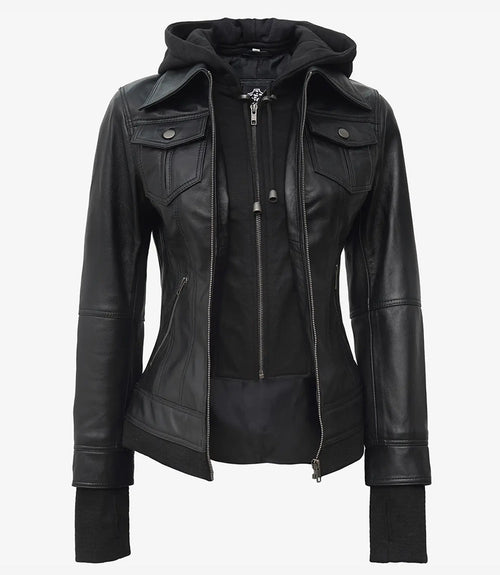
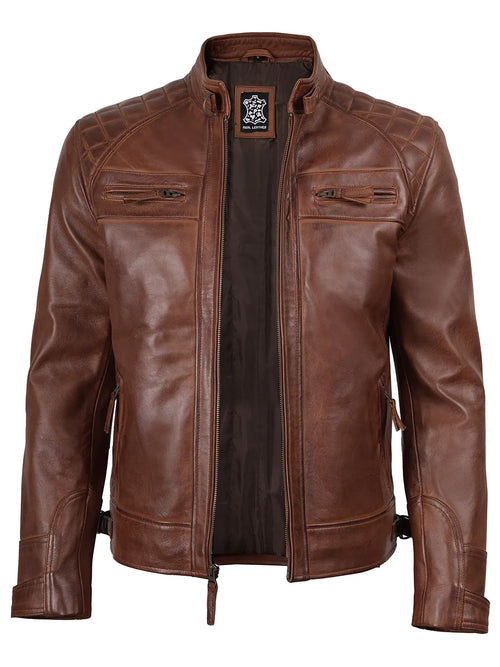
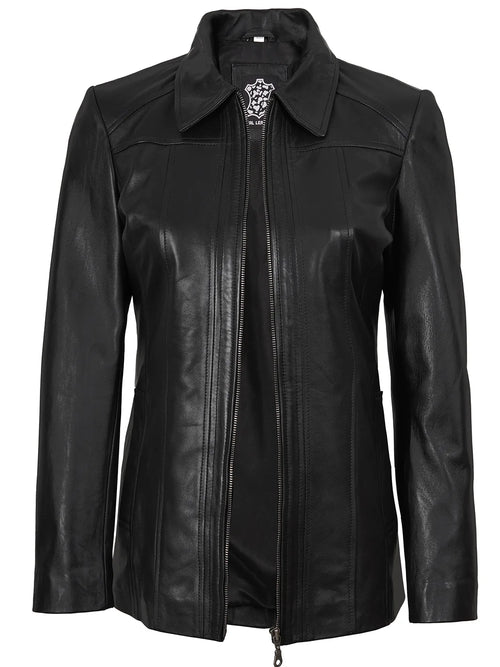
At Decrum, every jacket is made from full-grain nappa lambskin — the outermost layer of the hide, completely intact, drum-dyed at 0.6–0.8mm thickness so colour goes all the way through. No surface coating layered on top. No compressed leather dust. No fabric backing. A single, continuous piece of animal skin that will soften with every wear, deepen in colour with every season, and be with you for decades — not years.
Whether youre shopping for a mens leather jacket or a womens leather jacket, the difference between full-grain leather and bonded leather isnt a matter of taste or preference. Its a matter of whether youre actually buying leather at all.
The Real Thing
Full-Grain Lambskin — Specified, Verified, Built to Last

Frequently Asked Questions
Related guides: types of leather (grades & finishes) · how to tell if leather is real · full-grain vs top-grain · faux vs real leather


